Encyclopedia • TV • Sci-Fi Horror • 1980s
Hawkins Incident File • Upside Down • Final Chapter
Stranger Things
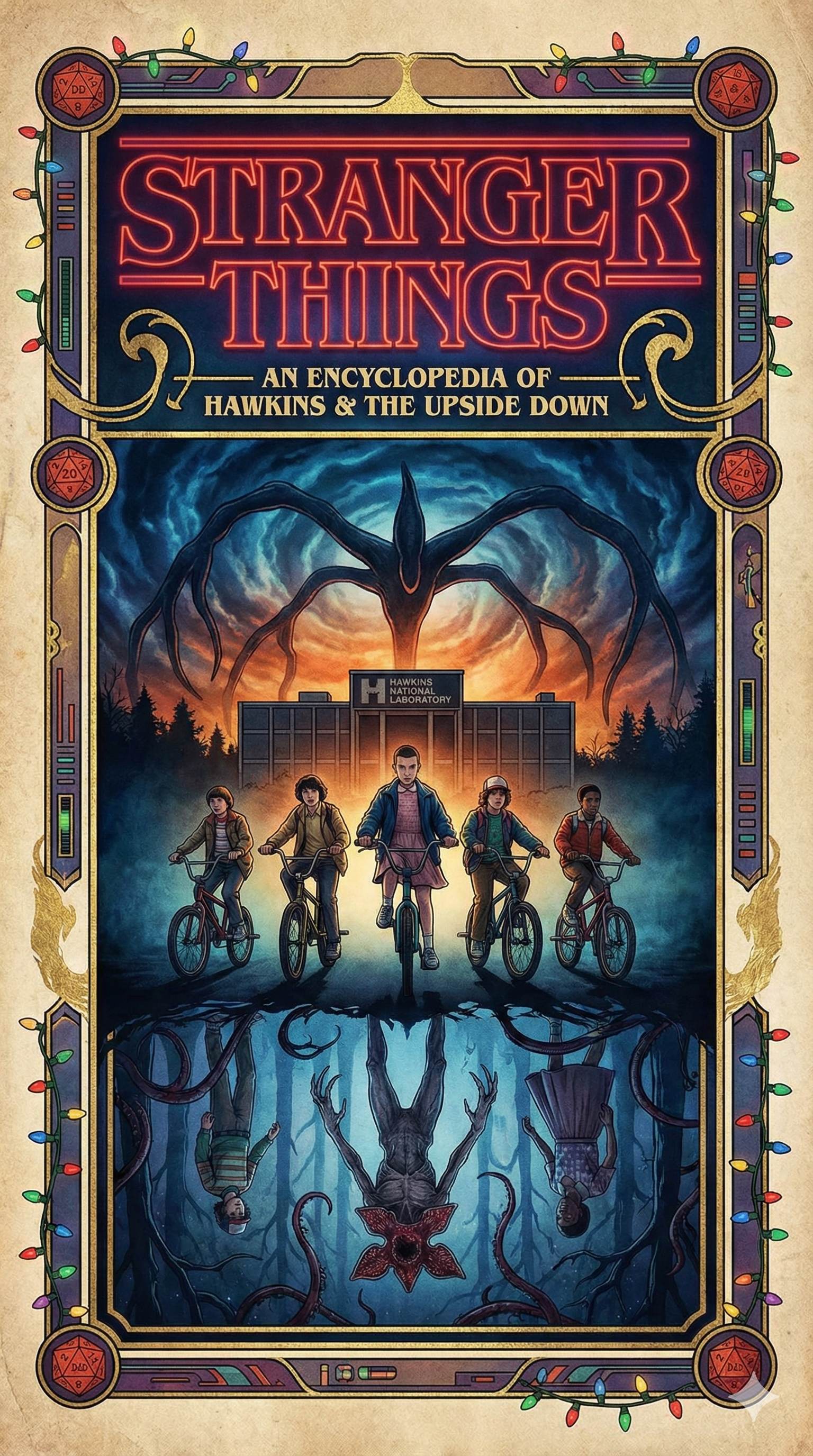
Stranger Things is your perfect “mystery engine”: a small town, secret experiments, missing kids, and a parallel nightmare world. This premium guide compresses the lore into fast, card-based intel: the Upside Down, Vecna-level threats, the rules of Eleven’s power, the factions, the monsters, and the season timeline.
Threat Model
From Creature to Conspiracy
The danger evolves: isolated monster encounters become coordinated, intelligent, reality-bending warfare.
Power Rules
Limits Create Tension
Psychokinesis has costs: focus, fatigue, emotional triggers, and environmental interference.
Trivia Value
Built for Quizzes
Every season hides repeatable “quiz anchors”: names, codes, objects, songs, locations, and tells.
Walkie-Talkies
Starcourt
Vecna
Gates
Upside Down
Fan-made encyclopedia for TheQuizRealm. Not affiliated with Netflix. Spoiler-sensitive sections are clearly labeled.
5
Seasons
42
Episodes
1983+
Timeline Era
Final
Season Arc
The Premise in One Minute
Setting
Hawkins, Indiana
A “nothing-ever-happens” town that becomes a battlefield between normal life and an invasive shadow dimension.
Catalyst
Hawkins Lab
Secret experimentation creates breaches that let predators, particles, and psychic influence leak into reality.
Wildcard
Eleven
A weaponized kid with telekinesis and remote viewing—powerful enough to close gates, vulnerable enough to break.
Threat
The Upside Down
An echo-world with hostile ecology, hive logic, and entities that learn you—then rewrite you.
Upside Down 101: Rules, Physics, and “Why It’s Scary”
Concept
Mirror World, Not a Dream
It resembles Hawkins but behaves like a biological system: spores, tendrils, and territory that reacts to intruders.
Atmosphere
Toxic + Particulate
Visibility is choked by floating particles. Respirators and filtration matter when time spent inside increases.
Intelligence
Hive Logic
Creatures act coordinated. If one sees you, the ecosystem “knows” you—patterns, routes, and fear responses.
Gates
Breaches Are Trauma Points
Openings aren’t random. They form under extreme energy/psychic stress and can spread when reality weakens.
Electricity
Interference & Signals
Tech and lighting behave strangely around rifts. Flicker becomes an early-warning system for “nearby.”
Horror Mechanic
It Invades Identity
The Upside Down doesn’t only attack bodies. It targets memories, guilt, grief, and turns them into weapons.
Survival Tip
Stay Quiet, Stay Together
Noise and panic are tracking beacons. A calm group is harder to isolate than a hero running solo.
Countermeasure
Heat Works
Fire and heat repeatedly show up as deterrents against organisms adapted to cold, damp shadow ecology.
Countermeasure
Music Anchors Mind
In psychic attacks, a strong emotional “anchor” can pull someone back when the enemy tries to hijack them.
Core Teams: Characters You Must Know
The Party
Mike • Dustin • Lucas • Will
The original “investigation unit.” Their strength is pattern recognition: they treat horror like a solvable game.
The Protector
Eleven
A walking plot twist: when she’s present, the team can fight back; when she’s gone, Hawkins collapses faster.
The Adults
Hopper • Joyce
Ground-level leadership: parenting under pressure, investigation under chaos, and ruthless commitment to “bring them home.”
The Teens
Steve • Nancy • Robin • Jonathan
The “street-smart squad” that turns everyday spaces—malls, houses, streets—into tactical arenas.
The Hellfire Energy
Eddie • D&D Culture
A social panic meets real horror. D&D becomes both a scapegoat and a language for naming the evil.
The Antagonist Axis
Vecna • The Hive
The threat gains strategy: psychological hunting, selective targeting, and long-form planning across seasons.
Monster Bestiary: Identify the Threat Fast
Hunter
Demogorgon
The “first contact” predator. Fast, lethal, and terrifying because it proves the gate isn’t theory—it’s open.
Pack
Demodogs
Same nightmare logic, multiplied. When the threat becomes a pack, Hawkins becomes a hunting ground.
Entity
Mind Flayer
A presence more than a body: infiltration, possession, and strategic pressure on communities.
Weaponized
The “Meat” Monster
Body horror as a machine: assimilation into mass, turning townspeople into raw materials for a siege.
Apex Mind
Vecna
A villain built from psychology: guilt, shame, and trauma become the entry points for a kill sequence.
Swarm
Upside Down Bats
A reminder that the ecosystem has layers: not every threat is a “boss,” but every threat can kill.
Environment
Vines & Tendrils
The world itself restrains, senses, and reacts—turning corridors into traps and rescues into puzzles.
Telltale
Flicker, Frost, and Silence
If the air changes and lights stutter, treat it like radar: it’s not “mood,” it’s proximity.
Seasons Timeline: A Clean Cheat Sheet
1983
Season 1: The Vanishing
Missing kid case turns into a lab conspiracy. First confirmed gate activity. Eleven becomes the team’s miracle and liability.
1984
Season 2: Infection & Expansion
The threat shifts from “one creature” to “a system.” Possession logic appears. The town is no longer innocent.
1985
Season 3: Starcourt War
Bright mall aesthetics hide a darker machine. The story becomes a siege: community spaces become battlegrounds.
1986
Season 4: Vecna Revealed
Spoiler-sensitive: the villain becomes personal. Psychic horror replaces pure creature horror, and Hawkins fractures socially.
Final Arc
Season 5: The Endgame
The final chapter is designed as a closure season: unanswered questions converge, alliances harden, and Hawkins becomes the front line.
Quiz Tip
Track “Firsts”
First monster, first gate, first code, first location discovery—these are prime quiz questions.
Quiz Tip
Objects = Anchors
Walkies, bikes, tapes, uniforms, and food brands often carry plot utility and fan-memory weight.
Quiz Tip
Emotional Triggers
The series repeatedly uses emotion as a mechanic: fear, grief, and love change outcomes.
Artifact Vault: Iconic Objects That Show Up in Quizzes
Food
Eggo Waffles
A simple brand becomes character shorthand: comfort, childhood, and identity in one bite-sized signal.
Culture
D&D References
The gang names threats like a campaign: it’s how they translate the unexplainable into actionable strategy.
Communication
Walkie-Talkies & Codes
In a pre-smartphone world, communication is tactical. Frequencies, call signs, and timing matter.
Disguise
Scoops Ahoy / Starcourt
A bright uniform becomes a stealth tool. “Mall energy” is the cover for maximum danger.
Survival
Music as an Anchor
Songs can function like rope in a storm: a stable personal memory that prevents total psychic takeover.
Mobility
Bikes & Neighborhood Routes
Chases become geography questions: which house, which street, which shortcut—prime quiz material.
Choose Your Challenge Level
Start easy, then go “Upside Down hard.” You’ll feel the difficulty curve instantly.
Frequently Asked Questions
Is the Upside Down “Hell”?
Not exactly. It behaves more like a hostile parallel ecology that can learn, spread, and weaponize human psychology.
Why do lights flicker?
Electromagnetic interference is a recurring signal: it’s your “radar ping” that something is close or a boundary is thin.
Is Eleven’s power unlimited?
No. Power is consistently tied to strain, focus, and emotional triggers. When she overextends, consequences follow.
What makes Vecna different?
He hunts through mind and memory. Instead of chasing you physically, he isolates you psychologically, then executes.
Can I use this page as a spoiler-free guide?
Yes. Most cards are spoiler-light. Any season-specific reveals are marked as spoiler-sensitive.
Where do I start if I want the hardest questions?
Go for object-details and micro-facts: code words, locations, music cues, and the names of operations and facilities.
Sources & References
These are the primary public references used for high-level facts and navigation context. (This page is fan-made and designed for quiz preparation.)