The Origin Archive • Vol. I

You are a
Reaction.

Your personality is not random. It is an adaptation to the family system that raised you.
Trace the roots of your behavior.

The Origin Stories

The Eldest Daughter
Syndrome.

It is an open secret in psychology: The Eldest Daughter is rarely just a child. She is the "Third Parent." From a young age, she is tasked with emotional labor, conflict management, and setting the example.

This results in a personality profile characterized by High Conscientiousness and Pathological Self-Reliance. As an adult, you may find it impossible to ask for help because your brain equates "needing needs" with "failure."

> Validate Your Trauma
The Glass Child
Phenomenon.

A "Glass Child" is a sibling of someone with high needs (illness, disability, behavioral issues). The parents look *through* the healthy child to focus on the one in crisis.

Glass Children learn to be invisible. They become Hyper-Independent and believe that being "good" means "requiring zero attention." If you feel guilty for taking up space or having problems, you may be operating on Glass Child programming.

> Assess Invisibility
Deep Work

Reparenting Tools

The "Good Enough" Audit

For those raised by perfectionists. Calculate the difference between "Excellence" and "Trauma-Response Overachievement."

Begin Audit →

Boundary Architecture

Family systems resist change. Learn how to set boundaries with parents without guilt-spiraling.

Build Walls →

Heal the Root.

Understanding your origin is the first step to writing your own ending.

Decode Family History

The Pathology of Home

Enmeshment

The "Best Friend" Parent

When "Closeness" becomes Suffocation. Did you grow up feeling like you were your parent's therapist, confidant, or emotional support animal? This is not intimacy; it is Enmeshment. In these family systems, boundaries are viewed as betrayal. Individual identity is discouraged in favor of the "hive mind."

If you feel a crushing sense of guilt whenever you make a decision that differs from your family's wishes, or if you feel responsible for managing your parent's emotions, you are likely entangled. The goal of adulthood is Individuation—the ability to belong to a family without losing your self.

Check Boundary Permeability
01

The Golden Child

Chosen to represent the family's "perfect image." They receive praise, but it is conditional on performance. They grow up with a crushing fear of failure and a fragile identity tied entirely to external validation. They often struggle to know who they are without an audience.

02

The Scapegoat

Chosen to carry the family's shame. They are blamed for the family's dysfunction to distract from the parents' issues. Ironically, the Scapegoat is often the healthiest member (the "Truth Teller") because they are forced to leave the toxic system to survive.

Which role were you cast in?

Audit Your Role →
Inheritance

It Didn't Start
With You.

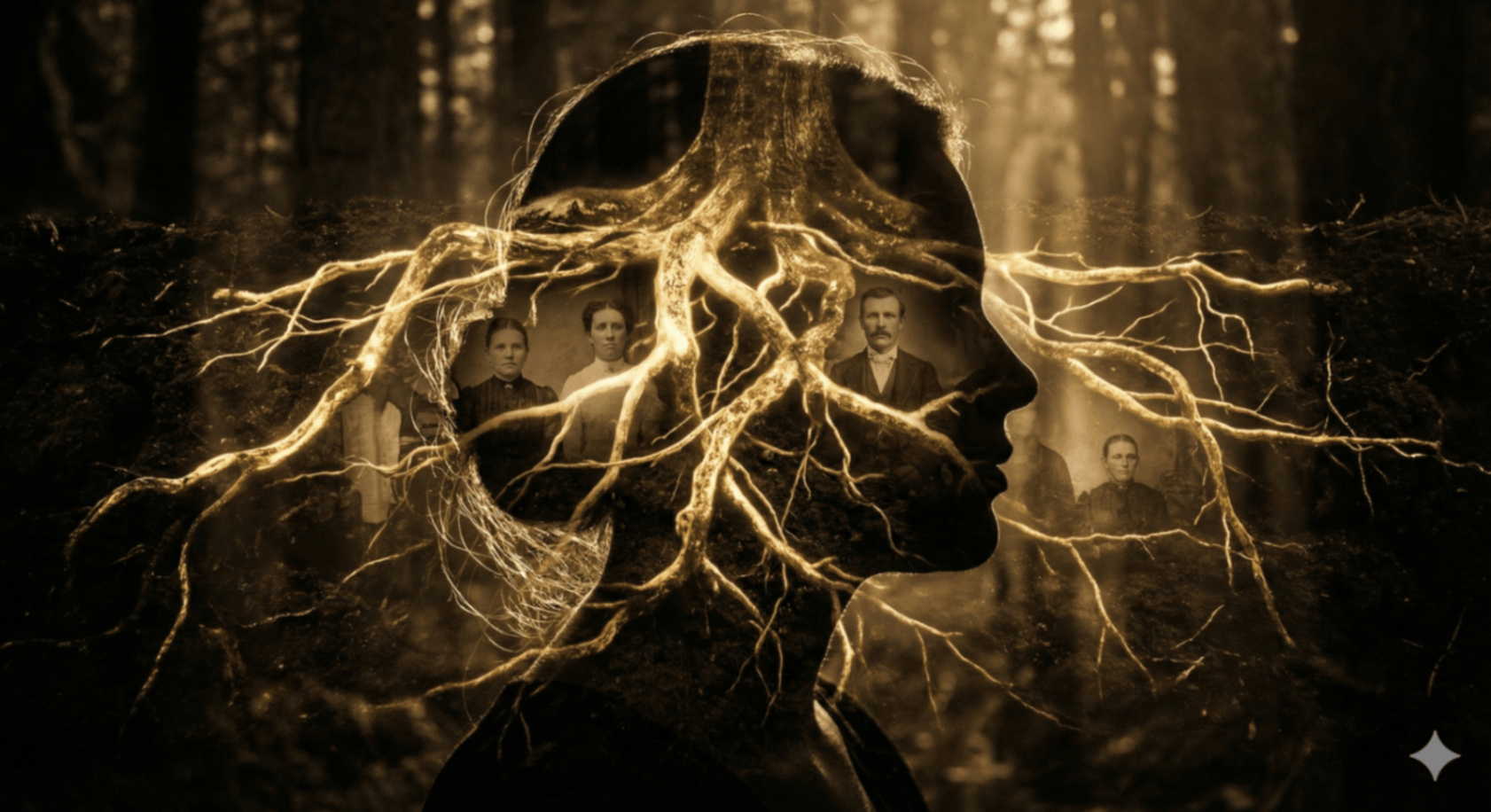
Cellular Memory. Science is now confirming what psychology has long suspected: Trauma can be inherited. Epigenetics shows that extreme stress alters the expression of genes, which can be passed down for generations.

If you have an unexplainable baseline of anxiety, a fear of scarcity despite being wealthy, or a terror of abandonment despite a secure partner, you may be carrying the "emotional luggage" of a grandparent.

This is not a life sentence. Neuroplasticity proves we can rewrite these pathways. But you cannot heal a wound you refuse to look at. You must trace the timeline of your anxiety back to its source—was it your experience, or your inheritance?

Explore Ancestral Patterns

The Chameleon Defense

"If I am useful, I am safe." Many people mistake being "nice" for having a good personality. In trauma psychology, extreme agreeableness is often a Fawn Response. It is a survival strategy developed by children in volatile homes.

If you can anticipate a parent's mood shift before they speak, if you suppress your needs to avoid conflict, or if you shape-shift to fit into any room, you are not just "adaptable." You are hyper-vigilant. You learned that being yourself was dangerous, so you became what everyone else needed.