Rick and Morty:
The Infinite Knowledge Hub
Welcome to the Citadel of Knowledge. This is the comprehensive database for the smartest (and most alcoholic) mammal in the galaxy. Rick and Morty isn't just a show; it's a nihilistic exploration of the Central Finite Curve.
// WARNING: Exposure to this content may result in existential dread, an urge to visit Blips and Chitz, or accidental dimension hopping. Proceed with caution.
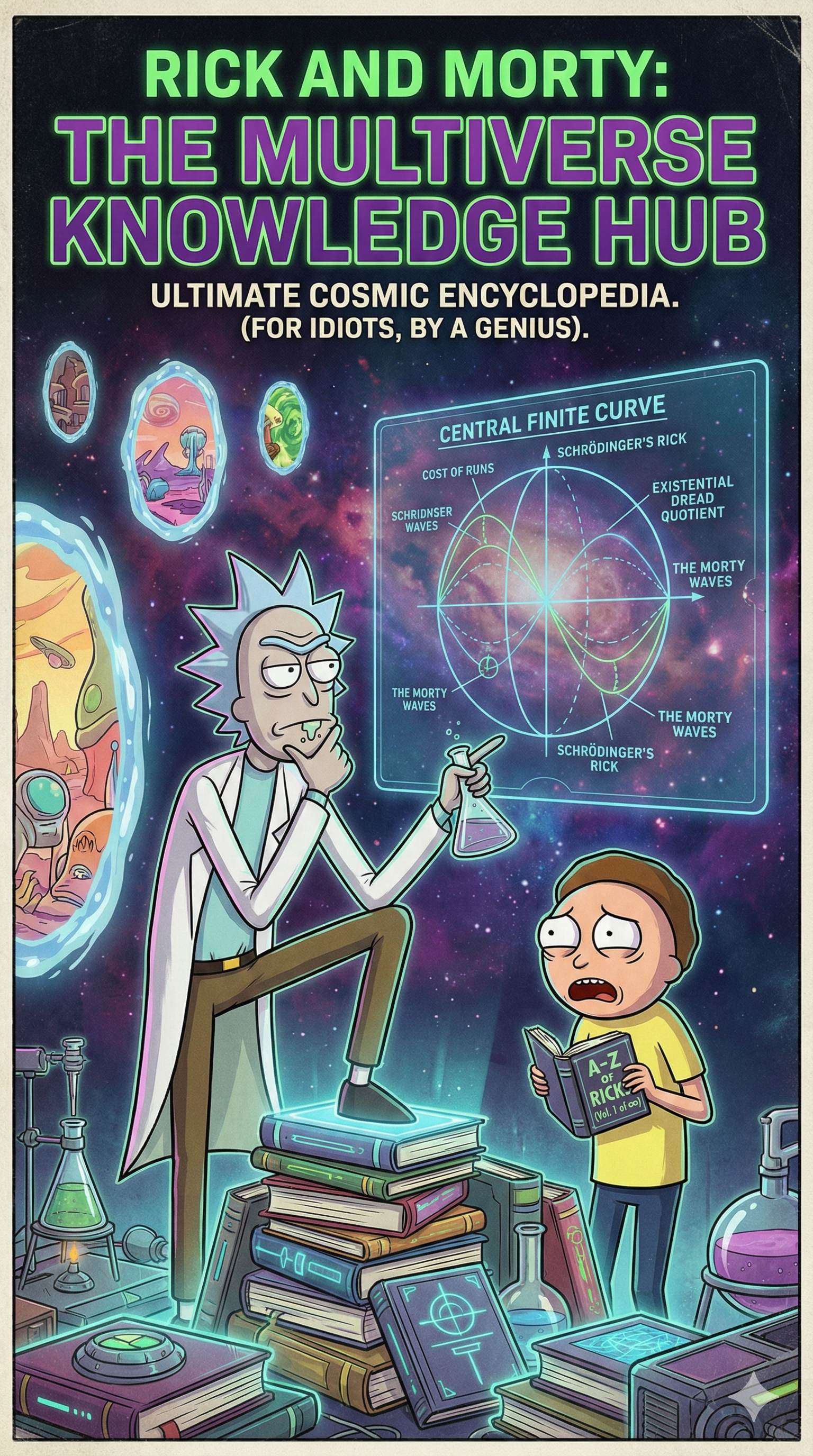
The Central Finite Curve
The multiverse is infinite, but Rick Sanchez didn't want to deal with infinite geniuses. He built the Central Finite Curve—a walled-off subset of infinite realities where Rick is the smartest man in the universe.
Outside this curve lies true chaos: universes where Ricks are dumb, where Ricks are suppressed, or where things far scarier than Rick exist. Evil Morty's grand plan was simply to break this crib and escape to the true multiverse.
Family & Foes
Tech & Locations
The Portal Gun
Rick's signature tool. It utilizes localized fluid to rip holes in spacetime, allowing instantaneous travel between dimensions. Green portals are within the Curve; Gold portals go beyond.
The Citadel of Ricks
A massive space station where Ricks and Mortys from thousands of realities formed a government. It has been destroyed and rebuilt multiple times. Capital of the bureaucracy Rick hates.
Meeseeks Box
A gadget that summons a blue humanoid named Mr. Meeseeks. Their singular purpose is to complete one task and then vanish. "Existence is pain" for a Meeseeks.
Multiverse Database: How to Read This Hub
This page is structured like a Citadel reference terminal: short entries, clear headings, and quick mental hooks. If you are here for trivia prep, you can skim the bold keywords and still come away with usable knowledge for quizzes, debates, and “wait… what happened again?” moments.
If you are here for lore accuracy, this hub prioritizes what the show explicitly establishes: character identities, major arcs, faction conflicts, and the mechanics that keep the multiverse from collapsing into narrative soup.
// Editorial principle: If it is ambiguous in canon, we label it ambiguous. If it is confirmed, we treat it as confirmed. No “fan theory” presented as fact.
The Multiverse, Explained Like You Actually Live Here
The core trick of Rick and Morty is that it treats “infinite realities” as a logistical problem, not a magical one. Infinity is not romantic. It is messy.
When you hear “there are infinite Ricks,” the show immediately follows with the uncomfortable part: if there are infinite versions of you, your personal tragedies and victories stop feeling unique. That tension is the engine behind both the comedy and the nihilism.
The Central Finite Curve is Rick’s attempt to put a fence around infinity. It is the multiverse, but curated. A subset engineered so that, in those contained realities, Rick holds the top intelligence slot.
That constraint is not just lore flavor. It changes everything: it creates social class systems for Ricks, it enables the Citadel bureaucracy, and it turns Mortys into a resource rather than a family member.
“Finite” does not mean small. It means controlled. The Curve is a boundary that makes the multiverse navigable for Ricks who prefer being the apex predator.
Beyond the Curve is the “unfiltered” multiverse: realities where Rick is not the smartest, and where threats exist that are not obligated to respect Rick’s narrative dominance.
Portal Tech: The “Rules” That Keep It From Being Pure Magic
The portal gun is iconic, but the show consistently treats portal travel as a dangerous, engineered process. Portals are not a casual “fast travel menu.” They are a weaponized shortcut through reality with consequences.
One of the cleanest pieces of visual language in the series is portal color. It communicates scope. It communicates jurisdiction. It communicates whether you are staying inside Rick’s sandbox or stepping into a wider universe that does not revolve around him.
The “standard” portal visual associated with Rick’s usual range. In hub language: routine jumps, familiar rules, and problems that typically have a Rick-shaped solution.
A visual signal of “beyond the normal constraints.” If green is a highway system, gold is a breach. It implies access that is not limited to the same map.
The show frames portal travel as chemical and mechanical. “Portal fluid” is not just goo; it is a resource with scarcity, security, and strategic value.
// Trivia hook: If a character controls portal access, they control movement, escape routes, and who gets to rewrite the situation.
Citadel Politics: Why Infinite Ricks Still Built Paperwork
The Citadel of Ricks is a blunt joke with a sharp edge: even the smartest man in the universe can reproduce the same social failures at scale. Replace “countries” with “dimensions” and you still get corruption, inequality, elections, and propaganda.
The Citadel becomes a mirror. It shows what “Rick-ness” looks like when it is normalized. When “I am the genius” stops being special, it turns into a labor economy. Some Ricks become police. Some become factory workers. Some become rich. Most become irritated by the system they created.
Mortys are treated like camouflage, leverage, and labor. The fact that this is presented as routine is the horror under the comedy. It is also a major reason a “Morty who refuses the role” becomes such a threat.
Evil Morty understands that the system is built on Rick’s arrogance and Rick’s dependency on predictable structure. He turns that structure against the Citadel itself, using its machinery as an exit strategy rather than a home.
If you want a practical takeaway: Citadel politics is not “side lore.” It is the show explaining that infinite options do not create freedom by default. Freedom requires breaking the controlling logic behind the options.
The Smith Family: The Real “Home Base” Conflict
It is easy to label the Smith family as a sitcom anchor for sci-fi adventures. But the deeper pattern is that the family is the pressure vessel. Every multiverse event eventually returns to a very human question: what do you do when someone you love is powerful enough to ruin your life in creative ways?
Beth’s arc is built around identity and resentment. She lives in the shadow of a father who treats universes like a hobby. Her competence is real, but it is constantly undermined by the emotional damage of being “Rick’s kid.”
Summer is the character who adapts fastest. She refuses to be background. In trivia terms: if someone asks “who handles chaos surprisingly well,” Summer is often the answer.
Jerry is the low-status variable in a house full of big personalities. The show uses him to test a brutal idea: if you are anxious, dependent, and desperate for validation, the universe will constantly hand you opportunities to embarrass yourself.
// SEO note in plain language: “Rick and Morty family dynamics” is not fluff. It’s the connective tissue between the science-fiction and the emotional core.
Rick Prime, Diane, and the Cost of Revenge
Rick C-137’s most personal conflict is tied to Rick Prime, the Rick responsible for setting his life on a path of obsession. This is not framed as a heroic rivalry. It is framed as a wound that keeps reopening.
The show establishes that the Omega Device is capable of erasing a person across infinity. Its impact is not only physical absence. It distorts the emotional landscape: it turns grief into a problem that can never be “solved” by visiting another reality.
The point is not “wow, cool weapon.” The point is that infinite realities usually make loss feel reversible. The Omega Device weaponizes that logic by making loss irreversible across the multiverse.
If someone can be removed across all realities, the multiverse stops being a “backup plan.” It becomes a battlefield where permanent consequences are possible.
Rick’s intelligence cannot outbuild grief. He can replace worlds, bodies, and timelines. But he cannot engineer his way back to a version of life that was taken off the board entirely.
Characters That Matter for Quizzes (Beyond the “Top 6”)
Most trivia pages stop at Rick, Morty, Summer, Beth, Jerry, and a villain of the week. This hub is designed for the next level: the recurring characters and factions that shape the universe.
A major emotional anchor for Rick. Birdperson is not just “cool side character.” He represents loyalty, ideology, and the version of Rick that could have chosen connection instead of isolation.
A hive-mind ex who exposes Rick’s vulnerability: he wants intimacy, but he defaults to dominance. Unity’s presence turns romance into an ethical debate about control and consent at planetary scale.
A “rival” that is intentionally absurd. Nimbus is also a reminder that Rick’s reputation is not universal. In some social ecosystems, Rick is not the myth. He is the annoying guy everyone already knows.
Not a single villain, but a system. The Federation represents the kind of order Rick despises: rules imposed by people who believe power grants moral permission.
A recurring friend-of-Rick figure that blends comedy with consequence. Squanchy is often used to show how collateral damage lands on Rick’s “party friends,” not Rick himself.
The Meeseeks concept is the show’s philosophy in miniature: create a life for one purpose, then watch suffering appear when the purpose becomes complicated. It is a joke about how humans create meaning, then get trapped by it.
// Quiz advantage: secondary characters are where most “hard mode” questions live.
Episode Milestones (Season-by-Season, Spoiler-Light But Useful)
You do not need a full episode list to sound informed. What you need are milestones: the moments that reshape the world, redefine a character, or introduce a new rule. Use this section as a memory scaffold.
Establishes the “adventure of the week” surface while hinting that Rick is hiding real pain. Also introduces the show’s recurring trick: comedy that doubles as a character diagnosis.
Expands recurring characters and starts treating emotional fallout as part of canon continuity. The message is clear: there is no reset button strong enough to erase consequences.
Turns Rick’s reputation into a universe-level fact. The scale widens. The narrative starts interrogating whether Rick’s “freedom” is actually just escapism with better gadgets.
Doubles down on high-concept premises while continuing to develop the family as co-leads rather than passengers. The show becomes more explicit about how addiction, control, and avoidance shape Rick’s behavior.
The Central Finite Curve stops being a background concept and becomes a plot device with consequences. Evil Morty’s arc reframes Mortys from “sidekicks” into potential architects of their own escape.
Explores a world where previous structures do not feel stable anymore. Characters start negotiating what “normal” even means after repeated reality fractures.
The Rick Prime conflict reaches a definitive turning point, and the narrative asks the uncomfortable follow-up: if revenge was your main fuel source, what do you do when the tank is empty?
The eighth season aired as a ten-episode run (2025), continuing the post-Curve era where portal access and multiverse politics feel less predictable. In hub terms: the world is bigger, and the safety rails are weaker.
// Trivia strategy: “milestones” beat “episode names.” If you remember the cause-and-effect, you can survive almost any question format.
Philosophy, Without the Lecture: What the Show Keeps Saying
Rick and Morty is often described as nihilistic. That is accurate, but incomplete. The show does not simply say “nothing matters.” It repeatedly asks: if nothing matters by default, what do you choose to matter anyway?
Rick has the brainpower to reduce any belief to a punchline. The narrative repeatedly challenges whether that power is a gift or a prison. Being “right” all the time is not the same as being okay.
Portal travel can look like ultimate freedom. But it can also be the ultimate avoidance: leave the consequences behind by leaving the world behind. The show treats that as a coping mechanism, not a superpower.
When Rick acts “above it all,” the family pays the price. The series keeps returning to the idea that ego turns love into a transaction. The most dangerous weapon in the garage is not the portal gun. It is denial.
In a multiverse, replacement is always possible in theory. The show pushes back: a replacement is not the same person, even if the face matches. That is why certain losses remain permanent on an emotional level.
This is why the best trivia questions are not always about names and gadgets. They are about motives. They are about choices. They are about what characters keep doing when no one is forcing them.
“Science” vs. Sci-Fi: What’s Real, What’s a Joke, What’s a Metaphor
Rick and Morty borrows vocabulary from physics and engineering because it sounds precise. But the show is not a textbook. It is a satire that uses “science talk” to justify emotional chaos and comedic escalation.
Still, the series is consistent about a few realities: energy, logistics, and unintended consequences. When Rick “solves” a problem, the solution often creates a new, weirder problem. That is closer to real engineering than it looks.
In real systems, patching one failure can amplify another. The show exaggerates this, but the structure is familiar: a “fix” becomes a cascade.
Portals, instant cloning, and reality edits are narrative tools. They allow the writers to ask “what would a person become if consequences were optional?”
Many “science” mechanics function like metaphors for addiction, dissociation, and escapism. The tech is the costume. The conflict is the human part underneath.
// Human-readable rule: If a device appears once, it is probably a joke. If it reshapes character decisions across multiple arcs, it is probably core lore.
Trivia Training: Questions the Hub Is Designed to Answer
If you are using this page as a study guide, these are the question types you should prepare for. They show up constantly in quizzes because they reward real understanding instead of guesswork.
Examples: “What is the Central Finite Curve?” “Why does the Citadel exist?” “What does portal color imply?” These test comprehension, not memorization.
Examples: “What does Rick fear?” “Why does Evil Morty want out?” “What does Jerry want?” These are usually easier if you think in psychology instead of plot.
Examples: “Who opposed the Federation?” “How does the Citadel govern itself?” “What role do Mortys play in the system?” These reward understanding of power structures.
Examples: “Roy,” “Blips and Chitz,” “Interdimensional Cable,” “Pickle Rick.” These are flash-recognition questions, ideal for rapid-fire modes.
If you want a fast self-check, do this: explain the Central Finite Curve in two sentences. Then explain why Evil Morty escaping matters in two sentences. If you can do both without rambling, your lore foundation is solid.
Frequently Confused Details (Clarified)
The show uses universe labels to separate similar-looking characters with different histories. In hub terms: always track which version you mean when you say “Rick” or “Morty.” Many trick questions exploit label confusion.
The Citadel is a political concentration of certain Ricks and Mortys, not a universal home for every version. The multiverse is too large for a single institution to truly contain it.
When portal travel becomes restricted or redefined, the whole setting changes. This is why portal tech is treated like infrastructure, not just a gadget.
The narrative repeatedly asks whether a person is defined by their body, their memories, or their choices. This is why “clone” and “alternate self” plots hit harder than they should in a comedy.
SEO-Rich Glossary (Short, Useful, Non-Annoying)
A glossary sounds boring until you realize it is exactly what search engines and trivia players both want: clean definitions attached to recognizable terms. This one is written to be readable, not robotic.
A restricted section of the multiverse engineered so Rick remains the top intelligence in those realities. Creates order inside infinity, and a wall around what lies beyond.
A massive political hub where large numbers of Ricks and Mortys formed a structured society. Proof that even geniuses recreate bureaucracy.
Rick’s dimension-travel device, defined by its fluid-based operation and its ability to bypass normal distance and barriers. The show treats it like infrastructure and weaponry.
A recurring concept that frames infinite realities as infinite entertainment. It also functions as satire: when everything exists, even “TV” becomes absurdly meaningless.
A life-simulation game that compresses an entire human lifetime into an arcade experience. Frequently referenced as a symbol of identity being shaped by artificial systems.
A classic example of Rick turning therapy avoidance into an engineering stunt. Funny on the surface, revealing underneath.
// Search value: these terms match common “Rick and Morty lore” queries while staying genuinely readable for humans.
Next Step: Turn Lore Into Skill
Reading is nice. Winning is better. Use the quiz mode to lock this knowledge into recall speed.
Prove Your Intelligence
Are you a Rick, or just a Jerry? Take the test.