Decoder Index
scannable structure • intent matching • better dwell time
What a Global Cellular Coverage Map Really Shows
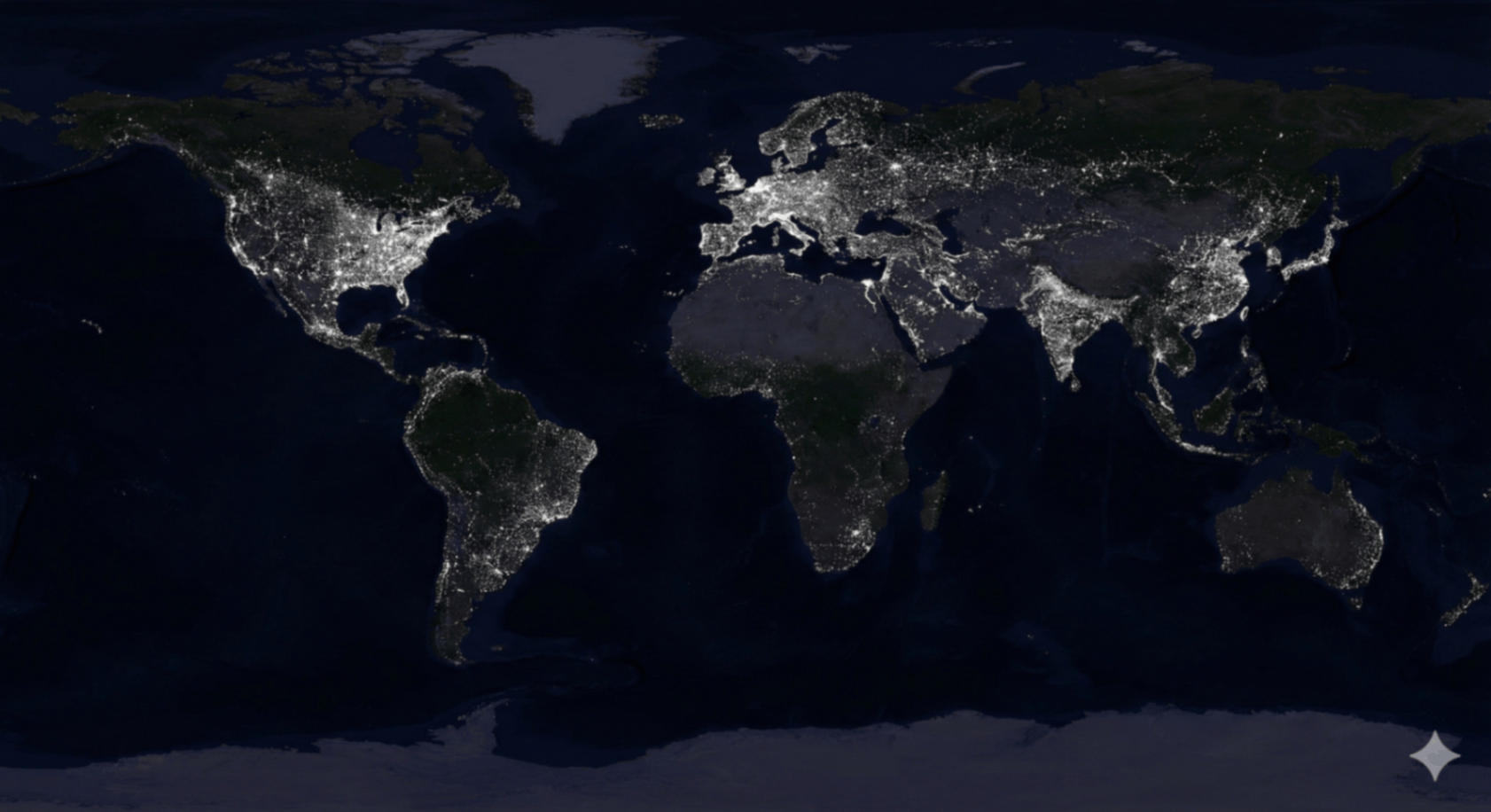
This heatmap is the footprint of the mobile internet: where your phone can negotiate a connection to the network—and what class of network it gets (2G through 5G).
It’s also a map of infrastructure priorities. In bright zones, connectivity behaves like a default utility: payments, navigation, education, telemedicine, messaging, and work access are always “on.” In dark zones, those same services become intermittent, expensive, or unavailable. That gap is the digital divide made visible.
Comparative reality check: a cellular coverage map is not the same as the internet backbone. Wireless is the access layer. The backbone is the hidden core. One shows where devices connect; the other shows how data moves after you connect.
Fast Decode (Key Takeaways)
quick answers • high intentCoverage means “can connect.” Performance depends on congestion, spectrum, and backhaul.
Fast in dense areas, weaker range in high-frequency bands. Cities win first.
Thin corridors follow roads, rails, and power routes—connectivity follows infrastructure and economics.
Cellular ends near the shore; ships and remote areas shift to satellite connectivity.
2G vs 3G vs 4G LTE vs 5G: What Changes on the Ground
The labels (2G/3G/4G/5G) are shorthand for generations of radio standards and network design. More “G” usually means better efficiency, lower latency, and more data capacity—but it also often demands denser infrastructure to deliver the promise.
The most useful mental model is comparative: low-frequency coverage travels farther, high-frequency capacity carries more data. Every country’s map is a compromise between physics, cost, regulation, and demand.
If you want to recognize this dataset quickly in The World Pulse, look for: city halos + thin connective veins + a hard coastline cutoff. Population density is blob-like; cellular is thread-like.
The “Last Mile” Paradox: Why the Signal Doesn’t Reach Everyone
The last mile isn’t a cable problem—it’s a return-on-investment problem shaped by physics. High-performance networks require more sites, more backhaul, and more maintenance. In low-density regions, the revenue per square kilometer is small while the infrastructure burden is constant.
This is why the dark zones aren’t merely “empty.” They are often classified by the market as expensive to serve. If coverage exists, it may be low-band, low-capacity, or intermittent. Connectivity follows profit, policy, and spectrum licensing—not just population.
Comparative insight: cities upgrade from 4G to 5G earlier not because they “deserve” it, but because density makes the business case work.
What “unconnected” means in practice
- Higher cost per GB (prepaid constraints, limited competition, metered plans)
- Lower resilience (single towers, weak backhaul, outage sensitivity)
- Lower opportunity density (jobs, education, services become “farther”)
- Lower information velocity (warnings, updates, and payments lag)
Translation: connectivity is not entertainment. It’s logistics for modern life.
Why Coverage Forms “Neon Veins” Between Cities
Cellular coverage is not a smooth blanket. It forms lines. That’s the tell. Providers prioritize corridors where demand is predictable: highways, commuter rail, freight routes, energy projects, and tourist roads. These corridors are also the easiest places to deploy and maintain equipment.
This is why cellular maps differ from population density. Population concentrates in cities. Connectivity concentrates in cities and along the arteries that connect them.
The Digital Divide: The Map of Opportunity (Not Just Signal)
“Connected” is not a vibe. It’s access to modern institutions. Where coverage is weak, the cost of doing basic tasks rises—time, money, and risk. This is why the same map can predict outcomes better than many economic indicators: it reveals who can participate in the default systems.
Remote learning, tutoring, and digital classrooms are easier where mobile data is stable. Weak coverage turns “online” into “sometimes.”
Mobile money and banking reduce friction—until the network fails. Coverage stability determines how reliable cashless life becomes.
Telemedicine, appointment systems, and health alerts require continuous connectivity. Gaps produce delayed care.
Warning systems and coordination collapse without coverage. In emergencies, connectivity is a force multiplier.
Satellite Internet vs Cellular: The Coverage Endgame
This map is primarily terrestrial. But the competitive frontier is orbital: LEO constellations aim to light up the dark zones from space, bypassing mountains and remote terrain. The trade-off shifts from geography to affordability and terminal availability.
Comparative framing: cellular wins where density allows cheap scaling and mobility is constant. satellite wins where towers cannot justify themselves—but the device cost and service economics define who benefits.
When each option wins
- Cellular: urban and suburban density, highways, commuter zones, indoor coverage upgrades
- Satellite: remote regions, maritime, disaster recovery backhaul, sparsely populated terrain
- Fiber: best cost-per-bit where it exists; cellular performance often depends on fiber backhaul
Takeaway: the “internet” is layers. Wireless is access. Fiber is muscle. Satellite is reach.
The Panopticon Problem: The Price of Being Connected
Every connected device is addressable. To access a tower, your device participates in identification, authentication, and handoff procedures. That creates logs. In practice, coverage is also the density of observability.
Towers and networks can infer movement patterns. The more coverage, the smoother the trace.
Control over the access layer enables throttling, shutdowns, and prioritization—connectivity is governance.
Comparative note: internet cables show capacity; cellular shows who can be reached instantly.
Signal Intelligence
field notes • pattern tells • comparative cuesSignal Canyons
Even in strong coverage zones, skyscrapers and stadiums create reflection, shadowing, and interference. Dense cities fix this with small cells, indoor DAS, and street-level nodes—why “full bars” can still mean slow data at rush hour.
Highway Veins
Cellular maps show thin luminous lines along transport corridors. This is the easiest “tell” versus population density. Where population maps are blob-like, cellular is string-like—cities stitched together by profit and logistics.
The Ocean Cutoff
Notice the sharp coastal edge. Terrestrial networks typically reach only limited distances offshore. Beyond that, ships move to satellite services. The modern internet still changes character at the beach.
The Leapfrog Effect
In many regions, the first “computer” is a phone. Mobile networks become the bank branch, the news channel, and the marketplace. That makes coverage density a proxy for institutional reach—not just entertainment access.
The Addressable World
Every tower is a handshake point: authentication, paging, and roaming. Connectivity increases convenience—and observability. Strong coverage makes services smoother; it also makes your presence easier to model.
From People to Things
The next iteration is machine coverage: meters, vehicles, logistics tags, sensors, robotics. That future network is more dense and more constant—coverage becomes industrial infrastructure.
Frequency Analysis
Can you distinguish cellular coverage from population, night lights, and the wired backbone under time pressure?
Start SimulationWorld Pulse Track: Networked Planet (Comparative Layers)
You understand this dataset faster by contrast. Cellular is the access layer. The wired backbone is the core. Night lights are the demand proxy. Air traffic is the movement layer. Together, they explain how modern life actually functions.
Internet Backbone
Fiber and submarine cables carry the heavy traffic. Cellular rides on top of this core.
The Night Shift
Electrification and economic density. Not identical to coverage—often revealing gaps.
The Noise Floor
Mobility layer. Compare where people move fastest vs where data can move instantly.
Glossary (Signal Terms People Actually Search)
Where a device can connect to a network generation (2G–5G). Not a guarantee of speed.
Local radio conditions and link quality; varies with buildings, terrain, weather, and congestion.
Radio frequencies licensed for mobile use. Lower bands travel farther; higher bands carry more data.
The connection from towers to the core network (often fiber). Weak backhaul can cap performance even with strong signal.
FAQ (Short, Snippet-Friendly)
Is this a 5G map? It’s a cellular map that includes multiple generations. 5G is one layer; coverage can still be primarily 4G depending on region.
Why do I have “5G” but slow internet? Congestion, limited spectrum, backhaul limits, or indoor signal conditions can bottleneck performance.
Why do some dense areas look weaker than expected? Regulation, investment priorities, and spectrum licensing can decouple coverage from population.